
Independent informational resource
Verbal autopsy and the InterVA model
Most of the world's deaths happen without a doctor present to certify the cause. Verbal autopsy — a structured interview with those who cared for the deceased — fills that gap, and models such as InterVA turn interview data into cause-of-death estimates. This site explains how it works and where to find the official standards, tools, and research.

01Why cause-of-death data matters
Reliable statistics on what people die from underpin public health policy: they decide which diseases get funding, which interventions are scaled up, and whether progress is being made. Yet a large share of deaths worldwide — particularly in low- and middle-income countries — occur outside health facilities and are never medically certified. WHO estimates that around two-thirds of deaths globally are not registered through civil registration systems. Verbal autopsy (VA) is the standard method developed to measure causes of death in exactly these settings.
02How it works
From a death outside a health facility to a statistic that shapes policy, verbal autopsy follows three steps:
Structured interview
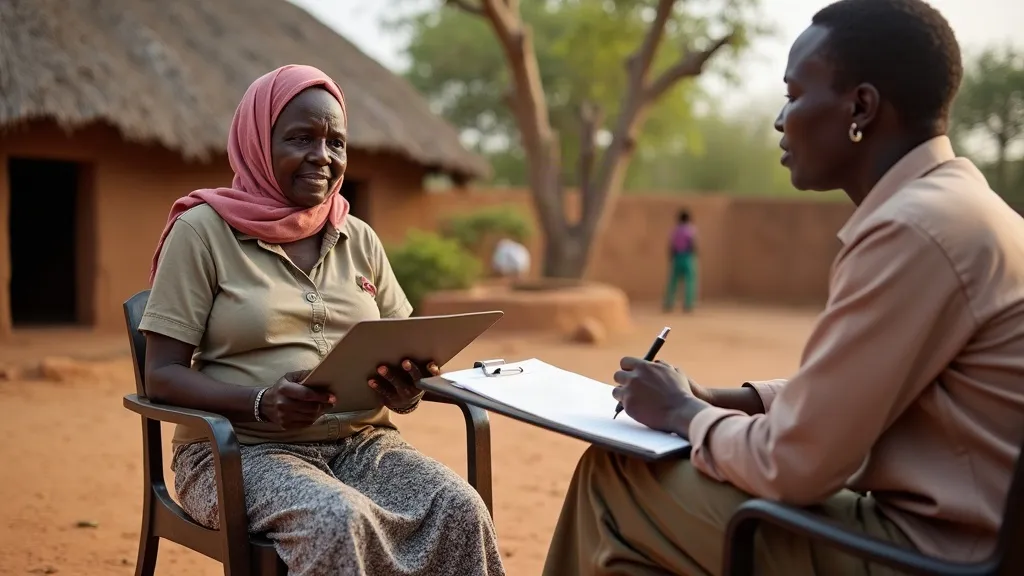
A trained interviewer asks the caregivers of the deceased about the signs, symptoms, and circumstances that preceded the death, using a standard WHO questionnaire.
02Automated interpretation
A Bayesian model such as InterVA compares the recorded indicators against its symptom–cause matrix and assigns the most likely cause of death.
03Cause-of-death estimates
Individual assignments are aggregated into population-level cause-specific mortality fractions — the statistics that inform health policy.
03What this site covers
interva.net is an independent reference on verbal autopsy methodology and the ecosystem of open tools built around it. The material is organised into four sections:
Verbal autopsy
The methodology itself: how VA interviews work, the WHO standard instruments (2007, 2012, 2016, 2022), and where the method is applied.

The InterVA model
History and principles of the InterVA family of Bayesian models for automated interpretation of VA data — InterVA-4 and InterVA-5.
Tools & software
An overview of the open tools used to process verbal autopsy data: InterVA4/5 for R, InSilicoVA, SmartVA, and the openVA toolkit.

Key research
A reading list of foundational publications on verbal autopsy standards and automated cause-of-death assignment, with links to the original papers.
04The WHO standards over time
The first consolidated WHO verbal autopsy standard.
A major revision, released alongside the InterVA-4 model.
An instrument designed for automated analysis by InterVA, InSilicoVA, and Tariff 2.0.
The current revision of the WHO instrument.
Full comparison of the WHO instruments →
05Featured research
PLoS Medicine, 2018
Nichols EK, Byass P, et al. "The WHO 2016 verbal autopsy instrument: an international standard suitable for automated analysis by InterVA, InSilicoVA, and Tariff 2.0."
doi:10.1371/journal.pmed.1002486Global Health Action, 2012
Byass P, et al. "Strengthening standardised interpretation of verbal autopsy data: the new InterVA-4 tool."
doi:10.3402/gha.v5i0.19281BMC Medicine, 2019
Byass P, et al. "An integrated approach to processing WHO-2016 verbal autopsy data: the InterVA-5 model."
doi:10.1186/s12916-019-1333-606A note on this domain
Between roughly 2006 and 2019, interva.net served as the public entry point of the InterVA project led by Professor Peter Byass and colleagues — the homepage simply redirected visitors to the project's pages at Umeå University and later at peterbyass.com. As a result, the domain is still cited as the InterVA reference in dozens of scientific papers, WHO-adjacent documentation, and reference works such as the Wikipedia article on verbal autopsy. This site now continues that role in an informational capacity: it documents the method and the model, and points readers to the official sources.
Disclaimer. interva.net is an independent informational resource. It is not affiliated with, endorsed by, or maintained by the InterVA project team, Umeå University, WHO, or any other institution mentioned here. No software is distributed from this site — please obtain the tools from their official sources, linked throughout. See About for details.