
Hyperbaric Chamber Fires and Fatalities: What the Incident Record Says Buyers Should Compare
A 1997 review found no fatal clinical chamber fire in North America; in 2025 two people died in chamber fires in the United States. Read as a cause-of-death file, the record points to a short list of design and operating questions any chamber buyer can check.
This digest usually works with deaths far from any device registry: a household interview, a fieldworker’s form, an algorithm assigning a probable cause. Deaths inside hyperbaric chambers sit at the other extreme. They are rare and heavily documented, down to CCTV timelines, manufacturer reports to the FDA and criminal filings. That makes them unusually good material for the question a cause-of-death analyst always asks: what actually killed this person, and what would have had to be different?
We read the record for one practical reader: the clinic owner or home buyer now shopping for a chamber. Both 2025 deaths happened outside hospitals, so the useful output is a short list of things to compare, each tied to a documented failure.
The baseline: 73 years, 77 deaths
The reference count is still a 1997 review by Paul Sheffield and David Desautels in Undersea & Hyperbaric Medicine, built from the published literature and the Undersea and Hyperbaric Medical Society’s mishap database. Between 1923 and 1996 they found 77 human fatalities in 35 hyperbaric chamber fires across Asia, Europe and North America. Twenty-five of those fires were in clinical chambers, eight in recompression chambers and two in diving bells. No fire fatality had been reported in a North American clinical chamber.
Three findings from that abstract still shape every design argument in the market:
- Before 1980, chamber fires were mostly caused by electrical ignition. After 1980, the main cause was a prohibited ignition source that the occupant carried inside.
- Every fatal fire happened in an oxygen-enriched atmosphere, above 28% oxygen, with plenty of material that could burn.
- The only survivors were in chambers pressurised with air, at below 23.5% oxygen.
A mortality analyst would call that a clean exposure gradient: cabin oxygen separated the fires people survived from those they did not.
The full paper fills in the detail. Between 1967 and 1996, 21 of 24 clinical chamber fires were fatal, with 60 deaths in all. Ten were started by things occupants carried in (hand warmers, a lit cigarette, spark-producing toys), seven by suspected static sparks, five by electrical faults, and two had no recorded cause. Burning rates climb sharply once oxygen passes about 25%, and in pure oxygen a fire becomes a fireball. The authors put it flatly: “No one has ever survived such a fire.” The one pressurised clinical fire with survivors was in a multiplace chamber breathing air at about 21% oxygen, where an outside attendant set off a water deluge system. NFPA 99 requires such systems in multiplace (Class A) chambers but gives no extinguishment guidance for pure-oxygen monoplace (Class B) chambers, since those fires are not considered survivable.
2025: two deaths, two different ignition sources
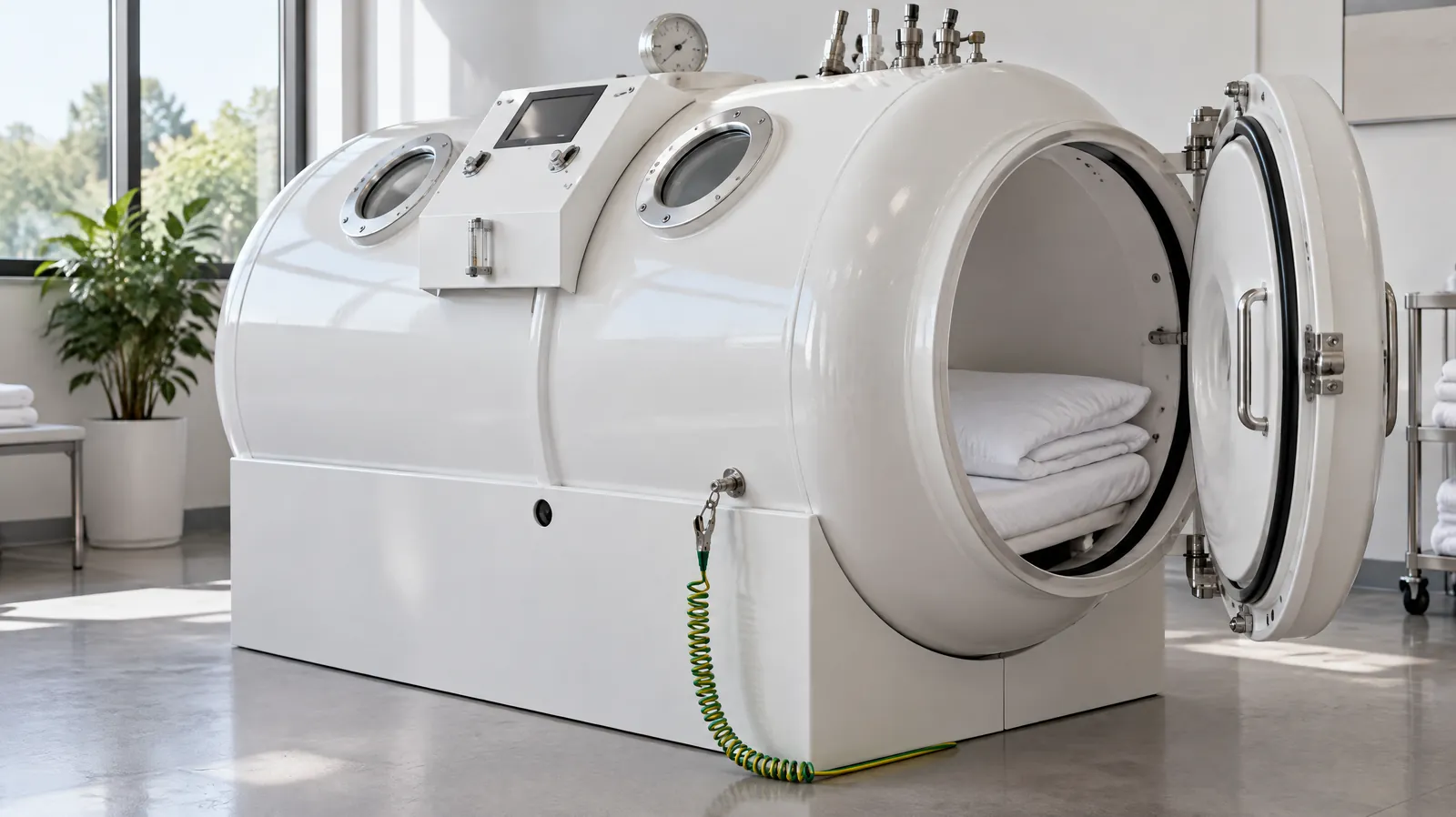
Troy, Michigan, 31 January 2025. Thomas Cooper, aged five, died at the Oxford Center in Troy during a session in an oxygen-filled monoplace chamber. The manufacturer, Sechrist, identified the unit to the FDA as a Model 3300HR. The most detailed public account comes from a report circulated by the UHMS, written by two hyperbaric specialists who reviewed the CCTV footage and examined the site with police investigators. Its timeline:
- The chamber was at 2.0 atmospheres absolute (ATA), and the fire started 42 minutes after pressurisation began. By then the atmosphere would have been close to 100% oxygen.
- Ignition appears to have come from an intense static discharge from the ungrounded child to the grounded chamber mattress, after his movement pulled the sheet away and his bare knee touched it.
- The door seal ruptured from the pressure rise less than three seconds after ignition. The door was opened at 52 seconds, and the fire flared again. Two minutes and 17 seconds passed from ignition to the end of the rescue attempt.
- The chamber itself was a code-compliant, FDA-cleared device and kept its structural integrity. Every chamber at the facility was properly grounded. There was no evidence that patient grounding straps were used on any of them, although the manufacturer’s manual says to check the patient grounding assembly before each use.
The authors’ conclusion is blunt: had the protocols in the manufacturer’s manual and NFPA 99 been followed, “this catastrophic event would likely not have occurred.” In March 2025 the Michigan Attorney General charged the owner and three staff members. In July 2026 the centre’s safety director pleaded no contest to involuntary manslaughter under an agreed sentence of 19 months to 15 years. The Attorney General’s statement accused him of letting “an outdated device” operate in defiance of safety standards. The charges against the other defendants are allegations, not findings.
Lake Havasu City, Arizona, 9 July 2025. A clinic founder died in a flash fire during a late-evening self-treatment inside a sealed OxyHealth Fortius 420 hard-shell chamber at 2.2 ATA. According to the MAUDE report filed with the FDA, responders found the remains of a phone, a tablet, a headset, earphones, battery power banks, charging cables, a fan and possibly a red-light device inside. They also found blackened, swollen masses, thought to be lithium-ion battery packs, which the reporter suspected were the ignition source. The chamber contained the fire without losing integrity. A second MAUDE report on the same death notes that he had recently completed a hyperbaric safety certification course. No final investigative finding had been published when that report was filed.
The maker’s page says the Fortius 420 ships with an air compressor and delivers 100% oxygen through a hood. The MAUDE reports do not give the cabin oxygen level at the time, so this case says nothing for or against air-pressurised designs.
Set side by side, the two deaths fit Sheffield’s pattern closely. In both, an enriched oxygen atmosphere met an ignition source that the operating rules exist to exclude. One was static from an ungrounded occupant, the other was battery electronics carried in. Neither pressure vessel failed.
What the FDA’s own data show
On 25 August 2025 the FDA issued a letter to health care providers. It said the agency was aware of fires causing serious injuries and deaths, that “the root cause of these events is not known,” and that it believes serious adverse events with these devices are rare. Its recommendations are operational: follow the instructions for use, use proper grounding equipment, train staff, supervise every session, keep electrical and static-generating items out, and dress patients in compatible fabrics such as cotton. It points readers to NFPA 99 and ASME PVHO-1, the pressure vessel standard for human occupancy.
The FDA’s adverse event database gives a rough denominator. As of openFDA’s 13 October 2026 update, 12 reports filed under product code CBF were coded as deaths. Four of them describe the two 2025 fires. One more, from 2015, describes a fire that killed a dog during veterinary oxygen therapy. The rest involve no fire: seizures and cardiac arrests during or after treatment, a ventilation accident and unverified complaints. MAUDE is a passive system: it undercounts, and devices sold outside the cleared CBF category may never appear in it.
Other regulators, and the code chain
Other agencies have gone further than the FDA letter. Health Canada says it has not licensed any soft-shelled hyperbaric chamber. It seized nine unlicensed units in 2020 and warns that “the risk of fire is significantly increased when the device is used in combination with an oxygen concentration device.” Australia’s Therapeutic Goods Administration issued a precautionary safety alert after the Troy death. Its advice to consumers is blunt: “Do not purchase a hyperbaric chamber for use at home.”
Within the United States, a 2025 consumer warning published by the UHMS sets out the code chain that many wellness buyers miss. NFPA 101, the Life Safety Code, applies NFPA 99’s hyperbaric chapter to chambers in any occupancy, not only hospitals. NFPA 99 in turn requires chambers to be designed and built to ASME PVHO-1. And PVHO-1 covers any vessel holding a person at a pressure difference above 2 psi, which takes in a 4.4 psi soft chamber. The same article reports a death from asphyxia in an unattended “mild” chamber at a home in North Carolina, and a soft chamber that ruptured with its occupant inside in India in September 2024.
Two kinds of risk that buyers tend to mix up
Fire risk depends mainly on how much oxygen is in the cabin atmosphere and on what gets carried inside. A monoplace chamber filled with 100% oxygen is the highest-exposure design, and it is also the standard design for hospital hyperbaric medicine. Sechrist’s 510(k) summary describes its chambers as built to administer 100% oxygen at up to 3 ATA. A chamber pressurised with air, with oxygen delivered through a built-in breathing system (BIBS) mask that vents exhaled gas outside the chamber, keeps the cabin near normal air. On Sheffield’s data, that is where the survivors were. It does not reduce the risk to zero. A leaking mask or a failed overboard dump raises the cabin oxygen level, and NFPA 99 occupant-grounding rules apply once the cabin exceeds 23.5% oxygen.
Structural and regulatory risk depends on what the vessel is and who certified it. Here the low-pressure end of the market draws the most criticism. A 2026 review by R.A. Murray in Undersea & Hyperbaric Medicine argues that soft-sided chambers and some “mild” hard-sided ones, typically designed for 3 to 5 psi, fail to meet FDA clearance, NFPA 99 and NFPA 101 codes, or ASME PVHO standards. It names fire, barotrauma, suffocation and structural failure among the risks. The soft-chamber clearances that do exist are narrow. Some sellers cite the FDA-cleared Gamow bag as their predicate device, but the UHMS warning points out that the Gamow bag was designed for compressed air only and is intended solely for acute mountain sickness at altitude. Adding an oxygen concentrator to a fabric chamber falls outside that clearance, and it is the combination Health Canada flags as the fire risk.
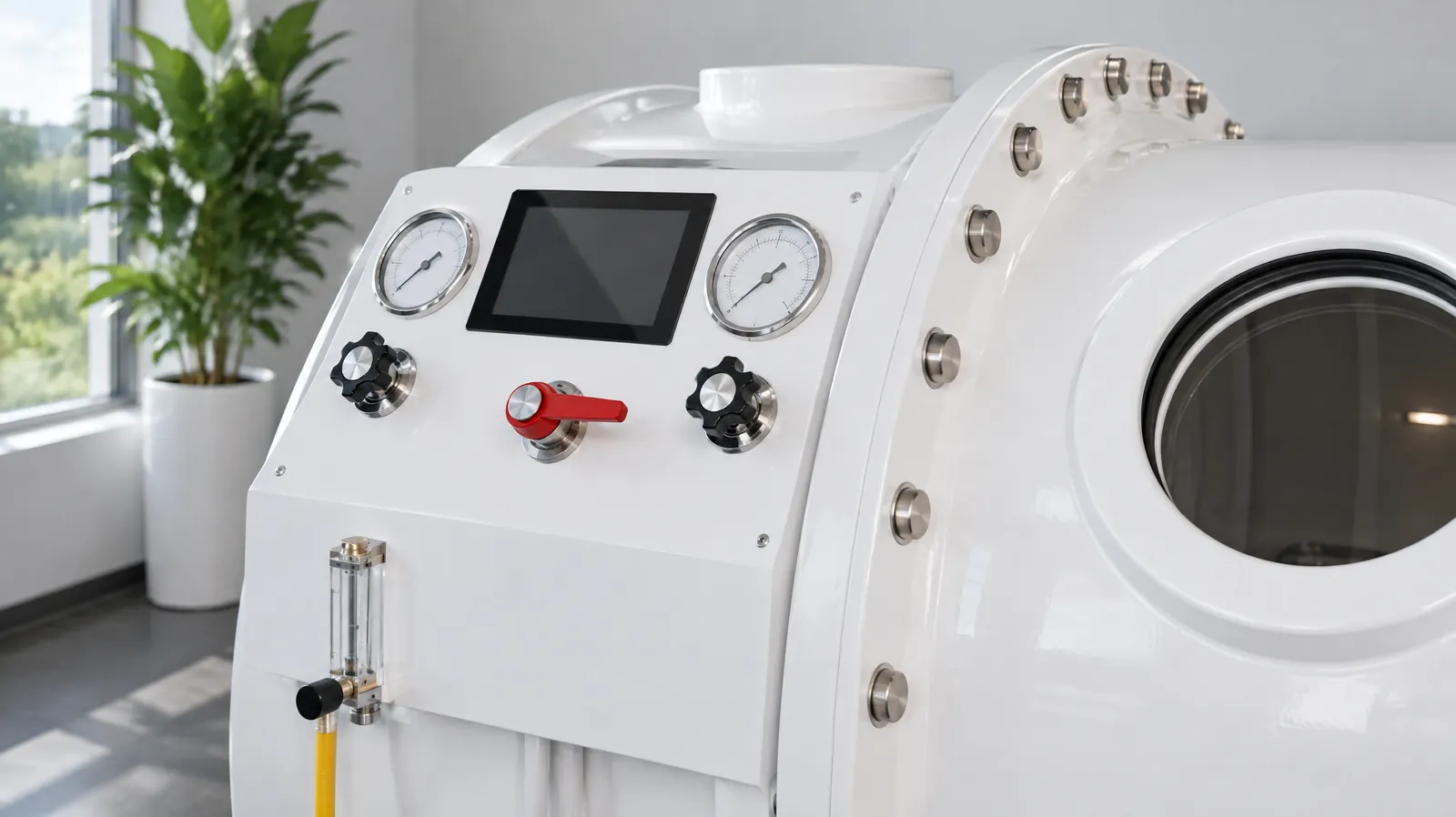
Comparing safety features across chamber types
The table sets common designs against the failure points in the record. The example models are ones whose specifications we checked on the manufacturer’s site or in an FDA filing. “Not stated” means we did not find the feature in the material we read. It does not mean the product lacks it.
| Feature | Soft-shell mild chamber (e.g. Summit to Sea Grand Dive, Newtowne) | Clinical oxygen-filled monoplace (e.g. Sechrist 3300H) | Clinical hard-shell with hood (e.g. OxyHealth Fortius 420) | Air-pressurised hard-shell with BIBS (e.g. Superhuman T2) |
|---|---|---|---|---|
| Rated pressure | 1.3 ATA (4.4 psi) | Up to 3.0 ATA | Up to 4.0 ATA (44 psi) | 2.0 ATA (1.5 selectable) |
| Cabin atmosphere | Room air from electric compressors | 100% oxygen | Air from an included oil-less compressor; 100% oxygen through a hood | Air; oxygen only through the mask |
| Inside PVHO-1 scope (above 2 psi)? | Yes, per the UHMS reading of PVHO-1 | Yes | Yes | Yes |
| Pressure-vessel paperwork | Fabric, no PVHO-certified vessel | Built to ASME Section VIII and PVHO-1 per 510(k) | “ASME PVHO-1 certified”, individually stamped and serialized | ASME-certified factory; design pressure-tested to PVHO-1 (“a pressure-testing certificate, not a PVHO certificate”) |
| FDA status | Newtowne cites 510(k) K051759; Summit to Sea says “FDA-cleared manufacturer” | 510(k) cleared, Class II | 510(k) cleared, Class II | No FDA clearance claimed; sold for wellness use |
| Occupant can depressurise or exit from inside | Zippers operable from inside or outside (Summit to Sea) | No; operator emergency vent, door locked above about 1 psig | Not stated | Yes, pressure release from inside |
| Pressure relief | Double vent system to cap at 4.4 psi (Summit to Sea) | Two relief valves set at 35 psig | Not stated | One manual valve, two automatic relief valves, one emergency relief valve |
| Occupant grounding | Not stated | Required by manual and NFPA 99 | Not stated | Not stated; maker says NFPA 99 is handled at facility level |
| Oxygen level display | Not stated | Not stated in 510(k) summary | Not stated | Pressure and oxygen level shown on inside and outside screens |
| Fire suppression inside the chamber | Not stated | None; NFPA gives no extinguishment guidance for this class | Not stated | Not stated |
| Intercom | Not stated | Two-way intercom | Not stated | Yes |
Two patterns stand out. No design in this set lists built-in fire suppression; that belongs to hospital multiplace rooms with water deluge systems. For everything smaller, fire safety is about prevention: keeping the oxygen level down, keeping ignition sources out, and grounding the occupant. And the feature that would have mattered in the Arizona case, a supervised session with an operator outside, does not appear in any spec sheet. It is a facility rule.
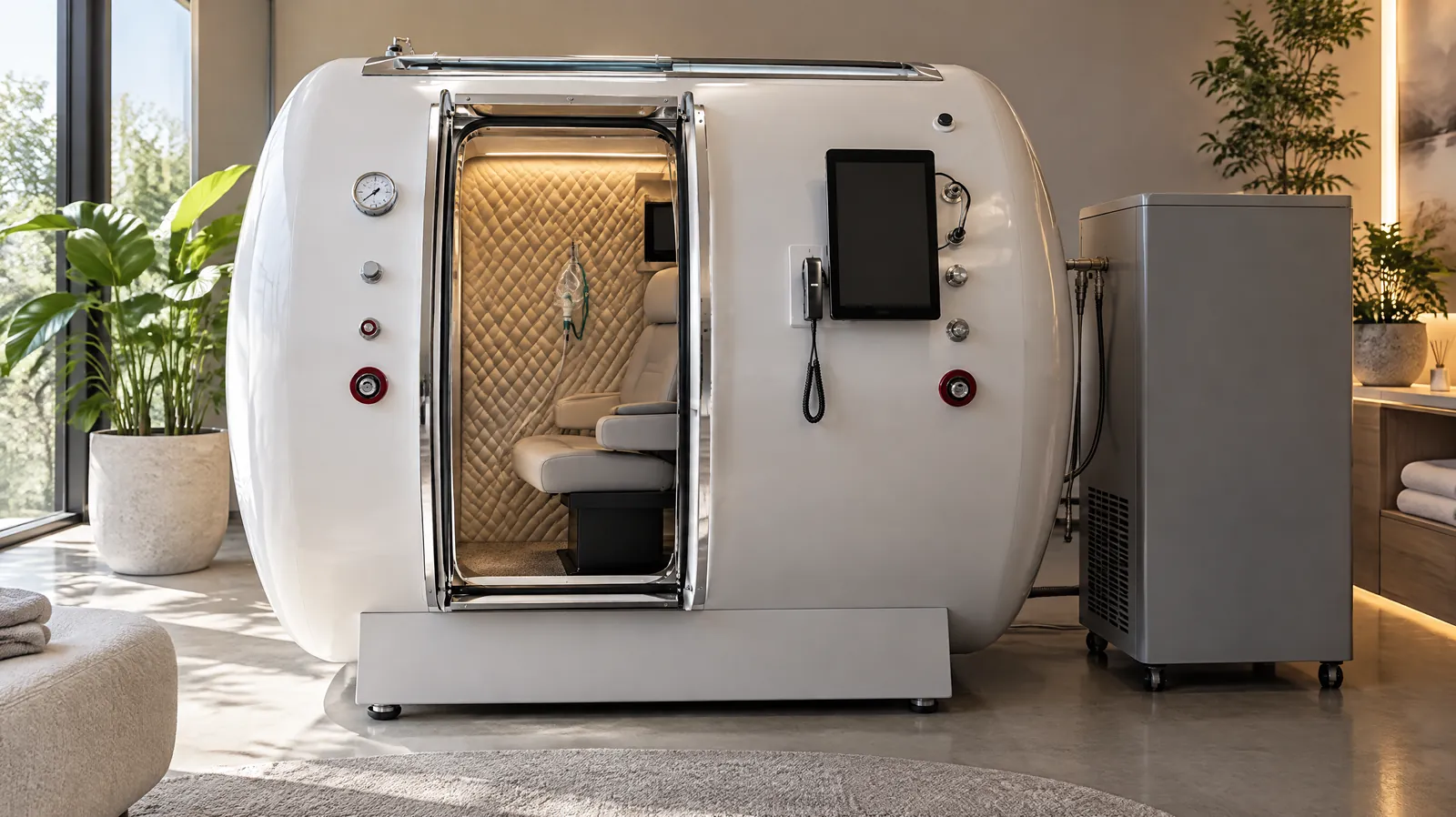
Among the air-pressurised hard-shells, Superhuman Chambers puts its documentation up front. Its hyperbaric chamber safety page walks through the fire triangle and what a buyer should ask to see. Its T-series pages give the PVHO-1 pressure-test wording above and offer the records on request. A buyer should still check the claims against paperwork. A statement that an air cabin “removes” fire risk deserves the same scepticism as any other marketing line. Ask for the oxygen analyser specification, the BIBS overboard dump design, and what the manual says about grounding and permitted items.
A buyer’s checklist drawn from the deaths
- Cabin gas. Is the chamber filled with oxygen or with air? If air, is the cabin oxygen level monitored and shown to the operator?
- Vessel paperwork. Ask for the PVHO-1 documentation and the ASME stamp or test certificate, and read the exact wording. A certified factory, a certified design and a stamped vessel are three different claims.
- Grounding. Does the manual require occupant grounding, and is the strap or other grounding hardware supplied? The Troy chamber was compliant. The fatal gap was a strap nobody used.
- Permitted items. Get the written list. In Arizona, the chamber held at least eight kinds of battery or electrical items.
- Exit and venting. Who can depressurise the chamber, from where, and how fast? The UHMS authors stress immediate decompression at the fastest possible rate, practised in drills.
- Supervision. Will a trained operator be outside for every session? The FDA letter treats this as a baseline requirement.
- Clearance against use. Match the FDA clearance, if there is one, to what you plan to do. A clearance for acute mountain sickness does not cover anything else.
Questions buyers ask
Can a hyperbaric chamber explode? The steel vessel held in both 2025 cases, in Troy despite a peak pressure likely several times its design rating. What happened was a flash fire whose heat spiked the pressure until the door seal ruptured. Soft chambers have a different failure mode: the UHMS has reported one rupturing with its occupant inside.
Is an air-pressurised chamber with a mask safe from fire? Safer, on the historical record, not immune. Sheffield’s survivors were all in air atmospheres, and NFPA 99 sets 23.5% oxygen as the ceiling for an air-filled chamber. A mask that leaks, or an exhaust line that dumps oxygen into the cabin, pushes the level up. That is why an oxygen analyser on the cabin matters.
Can I use an oxygen concentrator with a soft chamber? Health Canada says this combination significantly raises fire risk, and the UHMS says concentrators are not authorised for use with fabric chambers. No soft-chamber clearance we found covers it.
Should a chamber ever be used alone? The FDA asks for monitoring and supervision for the entire session, and the UHMS describes the North Carolina asphyxia death as happening in an unattended chamber.
What kind of evidence this is
Two recent deaths are too few for a rate, and the 1997 series is old and depends on what was reported. The UHMS consumer warning is a newsletter article by a certified hyperbaric technologist, not a peer-reviewed study, and its North Carolina and India cases are reported without detail. The Troy account is an expert report reviewed with police, not a court finding. The Arizona narrative comes from MAUDE reports, which the FDA itself says are not verified. The table reflects what manufacturers publish, not necessarily everything a product has. Still, across 73 years of fires and the two cases from 2025, the same three factors recur: oxygen in the cabin, an ignition source that should have been kept out, and a procedure that was skipped.
interva.net is an independent digest of verbal autopsy and cause-of-death research. It is not affiliated with, endorsed by, or speaking for the InterVA project, Umeå University, the WHO, the FDA, the Undersea and Hyperbaric Medical Society, or any chamber manufacturer named here.
Sources
- U.S. Food and Drug Administration. Follow Instructions for Safe Use of Hyperbaric Oxygen Therapy Devices: Letter to Health Care Providers, 25 August 2025 fda.gov
- Undersea and Hyperbaric Medical Society. Fatal Hyperbaric Chamber Fire in Troy, Michigan: an appeal to all users of hyperbaric chambers to heed the lessons learned (report dated 27 March 2026) uhms.org
- Sheffield PJ, Desautels DA. Hyperbaric and hypobaric chamber fires: a 73-year analysis. Undersea & Hyperbaric Medicine 1997;24(3):153-164 (PMID 9308138; copy hosted by the UHMS) uhms.org
- FDA MAUDE adverse event report 22796994: OxyHealth Fortius 420 hyperbaric oxygen chamber, event of 9 July 2025 accessdata.fda.gov
- openFDA device adverse event API: reports coded as deaths under product code CBF (hyperbaric chamber), data updated 13 October 2026 api.fda.gov
- FDA 510(k) summary K140559: Sechrist Model 3300H/HR and 3600H/HR monoplace hyperbaric oxygen chambers (2014) accessdata.fda.gov
- Health Canada. Unlicensed soft-shelled hyperbaric chambers may pose serious health risks (public advisory RA-61813, last updated 6 November 2020) recalls-rappels.canada.ca
- Melnyczenko A. Consumer warning: the dangers of soft-sided bag chambers. Pressure (UHMS newsletter), first quarter 2025 uhms.org