
Methodology
Verbal autopsy: interviewing for causes of death
Verbal autopsy (VA) is a method for determining the likely cause of death in places where most deaths happen at home and no medical death certificate exists. A trained interviewer asks the family or caregivers of the deceased a structured set of questions about the signs, symptoms, and circumstances preceding death.
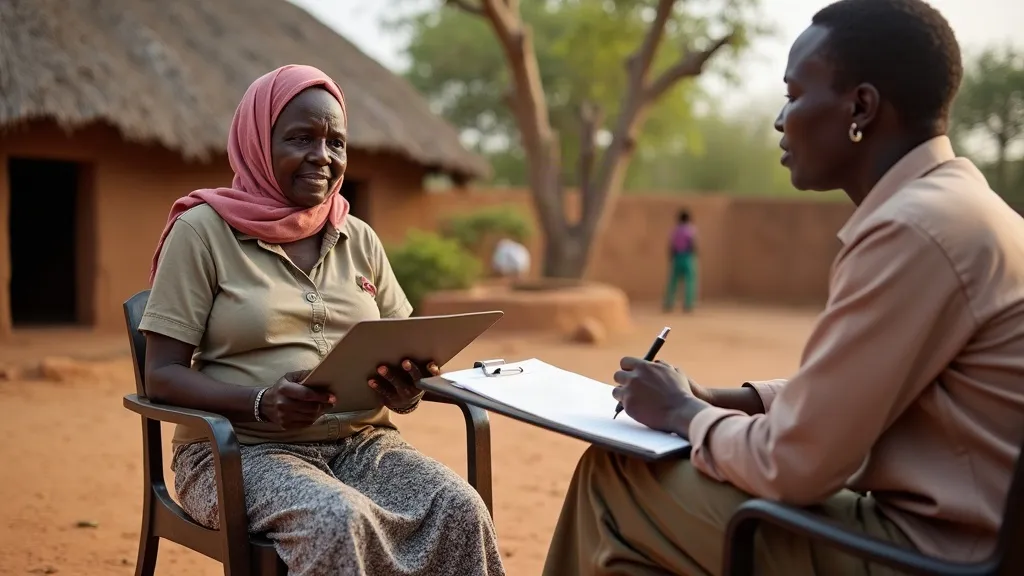
How a verbal autopsy works
The core idea is simple: even where no clinician examined the deceased, the people who cared for them usually remember what happened — fever, cough, injuries, the duration of illness, events during pregnancy, and so on. A VA interview captures this account in a standardised questionnaire, typically combining a short open narrative with closed questions about specific signs and symptoms. The completed questionnaire is then interpreted to assign a probable cause of death.
Interpretation can be done in two broad ways:
- Physician-coded VA (PCVA). One or more physicians read each questionnaire and assign a cause of death, usually following ICD rules. This was the traditional approach; it is expensive, slow at scale, and subject to between-physician variability.
- Computer-coded VA (CCVA). An algorithm or statistical model assigns causes automatically and consistently. Widely used approaches include the InterVA models, InSilicoVA, and the Tariff method implemented in SmartVA — see Tools.
The WHO standard instruments
The World Health Organization, together with partners such as the Health Metrics Network and the INDEPTH Network, has published successive international standards to keep VA instruments comparable across countries and studies:
| Year | Instrument | Notes |
|---|---|---|
| 2007 | Verbal autopsy standards: ascertaining and attributing causes of death | The first consolidated WHO VA standard, establishing a common questionnaire structure and cause-of-death lists. |
| 2012 | The 2012 WHO verbal autopsy instrument | A major revision designed from the outset to support automated interpretation; the InterVA-4 model was released alongside it. |
| 2016 | The 2016 WHO verbal autopsy instrument | Refined for routine use and explicitly designed to be suitable for automated analysis by InterVA, InSilicoVA, and Tariff 2.0 (WHO publication; Nichols et al., 2018). |
| 2022 | The 2022 WHO verbal autopsy instrument | The current revision, built around a short list of causes of death of public health importance that can be ascertained from VA data (WHO publication; WHO VA standards page). |
Where verbal autopsy is used
VA is applied wherever routine death certification is weak or absent:
- Health and Demographic Surveillance Systems (HDSS) — longitudinal research sites, many of them in the INDEPTH Network, that track births, deaths, and causes of death in defined populations across Africa and Asia.
- National mortality surveillance and CRVS strengthening — countries integrate VA into civil registration and vital statistics systems to estimate causes of deaths that occur outside facilities; WHO's SCORE technical package lists VA tools among its recommended standards.
- Large-scale studies and surveys — sample registration systems, demographic and health survey programmes, and research studies of maternal, child, and adult mortality.
Limitations
Verbal autopsy produces probable causes of death, not clinical diagnoses. Recall error, symptom overlap between diseases, and the quality of the interpretation method all affect accuracy. Validation studies consistently show that VA performs well at the population level — for cause-specific mortality fractions — but is less certain for individual deaths, and that automated methods achieve accuracy comparable to physician coding at a fraction of the cost and time. These trade-offs are the subject of much of the literature listed in Research.
Frequently asked questions
What is a verbal autopsy?
A verbal autopsy (VA) is a structured interview with the family or caregivers of a deceased person about the signs, symptoms, and circumstances that preceded death. It is used to determine the likely cause of death where deaths happen outside health facilities and no medical death certificate exists.
Who conducts verbal autopsy interviews?
Trained field interviewers — often community health workers — administer a standard WHO questionnaire, typically combining a short open narrative with closed questions about specific symptoms. No medical qualification is required to collect the interview itself.
How is a cause of death assigned from a VA interview?
In two broad ways: physician-coded VA, where doctors read each questionnaire and assign a cause, and computer-coded VA, where an algorithm such as the InterVA model, InSilicoVA, or the Tariff method assigns causes automatically and consistently. The main options are compared in Tools.
Where is verbal autopsy used?
Wherever routine death certification is weak: Health and Demographic Surveillance Systems across Africa and Asia, national mortality surveillance and CRVS strengthening programmes, and large studies of maternal, child, and adult mortality.
How accurate is verbal autopsy?
VA produces probable causes of death, not clinical diagnoses. Validation studies show it performs well at the population level — for cause-specific mortality fractions — but is less certain for individual deaths. Automated methods achieve accuracy comparable to physician coding at a fraction of the cost; see the studies in Research.
See also: the InterVA model · tools & software